

Portable Esperanza Cortés and Steve Silver
March 5, 2026
UNYIELDING BODIES
May 20, 2026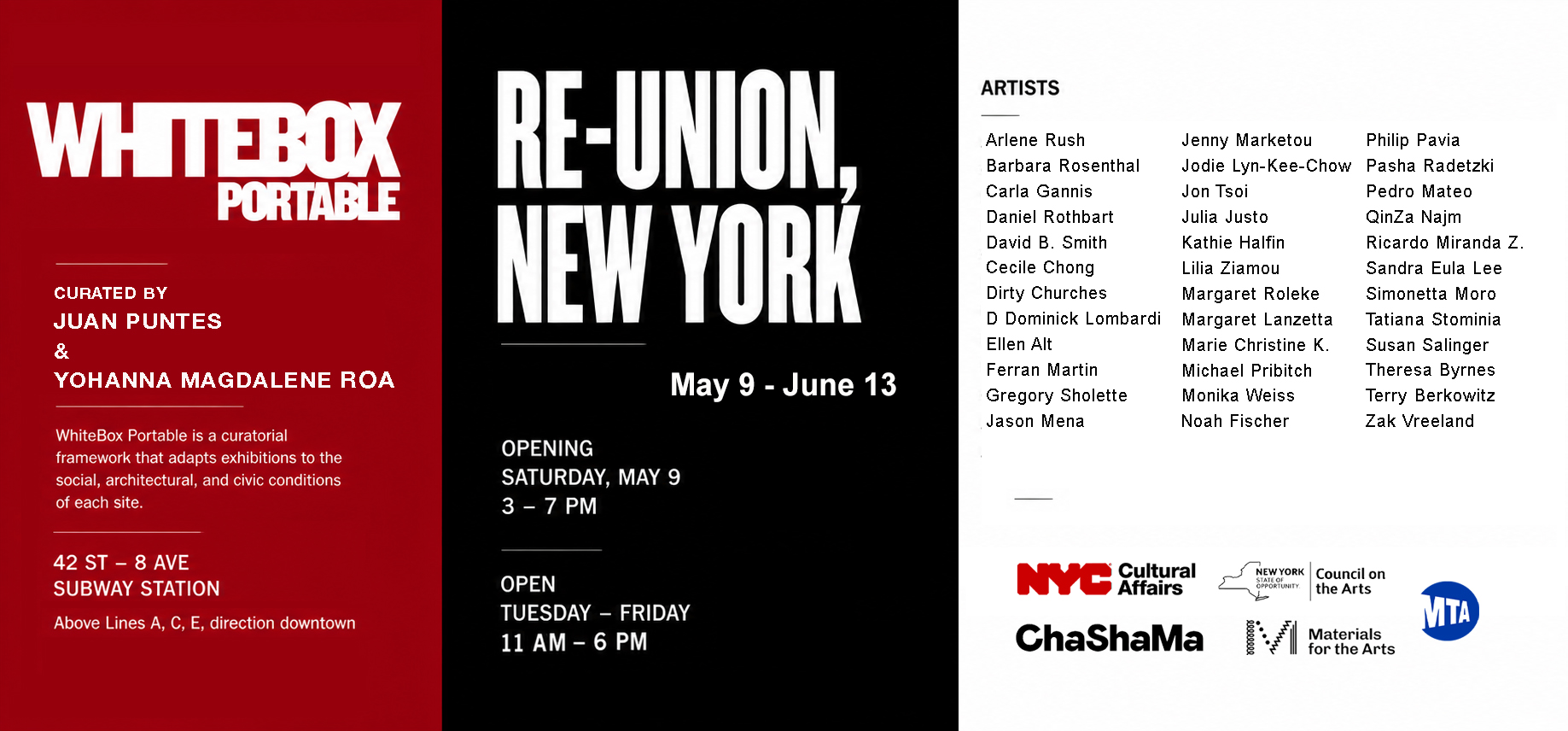
Re-Union, New York
WhiteBox Portable
Curated by Juan Puntes & Yohanna M. Roa
May 9 - June 13
Re-Union, New York, unfolds at a site of continuous transit: the 42nd Street–8th Avenue subway station, a dense urban node where over 200,000 bodies pass daily. Within this condition, the exhibition operates as an embedded structure, one that is exposed to movement, interruption, reflection, and the temporal instability of the public sphere.
This second iteration of WhiteBox Portable brings together artists who have been part of WhiteBox over the past three decades. Rather than consolidating a unified theme, the exhibition proposes a field of relations, an open constellation of practices that remain aligned through an ethos of experimentation, criticality, and responsiveness to context. The exhibition foregrounds the art-object as a site through which positions emerge, diverge, and coexist.
The spatial organization into three zones, white, black, and red, functions as a conceptual framework. These are not merely chromatic divisions, but operative conditions that structure how works are perceived, encountered, and related.
The white and red areas constitute a condensed WBX Portable cosmos: a fully activated field of three-dimensional works, in which proximity, suspension, and accumulation generate a dense network of relations. Each object retains its autonomy while participating in a shared spatial tension between containment and expansion, singularity and aggregation. Here, works engage questions of identity, migration, value, and systemic structures through processes of accumulation, transformation, and recontextualization. Found materials, symbolic objects, and hybrid forms reveal the latent economies, social, cultural, and ideological, that shape everyday life.
The black zone introduces a temporal and immersive condition. Within this space, Vitenis’s “J 2 Manhattan – The Eternal Traveler Syndrome in a Circular Motion” functions as a central axis. The installation, composed of six screens arranged in a semicircular formation, renders an endless loop of arriving and departing subway trains. This circular motion mirrors the infrastructural logic of the city while translating it into a perceptual and embodied experience. The viewer is positioned within this loop, confronted with a condition of perpetual transit: repetition without resolution, movement without arrival. The work situates the subject within a system that is both spatial and social, where circulation becomes a mode of existence.
Across the exhibition, recurring concerns emerge: displacement, fragmentation, and the unstable construction of meaning. Bodies, objects, and images appear in states of transition, circulating between contexts, histories, and systems of interpretation. Practices engage the porous boundaries between the personal and the collective, the local and the global, the material and the symbolic.
Re-Union is ga reactivation of a network, one that unfolds across time, memory, and institutional history. In this sense, the exhibition operates as both return and transformation: a re-encounter that does not stabilize, but rather reconfigures. Situated within the subway, a system defined by movement, convergence, and divergence, the exhibition reflects the conditions of the contemporary city itself: a space of continuous negotiation, where presence is always contingent, and meaning is produced in motion.