

WHITEBOX I PORTABLE
March 5, 2026
Re-Union
May 3, 2026
Esperanza Cortés
Title: The Couple
Steve Silver
Title: Color at the Speed of Light: ALBERT
WhiteBox Portable
Curated By Yohanna Magdalene Roa
The Exhibition is open: Tues - Fry, 12 - 6 pm.
WhiteBox Portable inaugurates a new curatorial framework developed within WhiteBox that responds directly to the conditions under which art circulates today. Conceived as a context-responsive methodology rather than a fixed exhibition model, Portable proposes that exhibitions must adapt to the social, architectural, and political realities of the spaces they inhabit. The first iteration of this project takes place at the 42nd Street–8th Avenue transit hub, a space provided by ChaShaMa and the Metropolitan Transportation Authority (MTA), at the intersection of the Port Authority Bus Terminal, one of the most intensely trafficked public infrastructures in New York City.
The exhibition, curated by Yohanna Magdalene Roa, unfolds across two large glass display windows embedded within an underground transit corridor, where the interior space remains fully visible from the surrounding flow. In this condition, the exhibition operates simultaneously as a gallery and an urban visual field. Passersby encounter the works while moving through the transit corridor, often only for a moment, while the installation itself remains continuously exposed to the city’s shifting rhythms of light, movement, and reflection.
Within this architectural threshold between interior and exterior, Portable activates the walls, floor, and spatial depth of the vitrine to construct installations that are both immersive and publicly legible. Rather than isolating art from the surrounding environment, the project embraces the contingency of the site, allowing works to engage directly with the flows of everyday urban life.
The inaugural presentation brings together two artists whose practices approach material and form as sites of transformation.
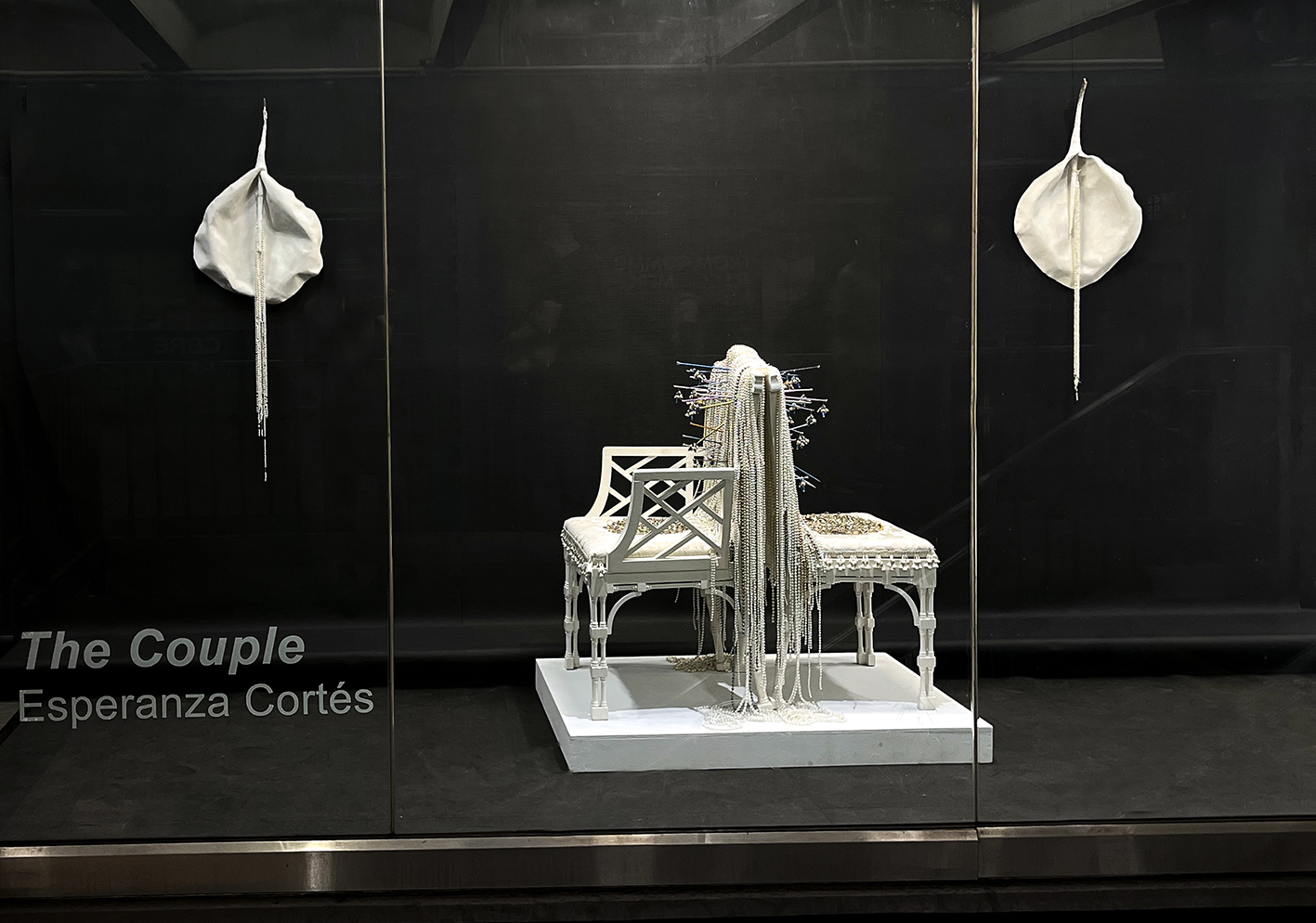
Esperanza Cortés. “The Couple.”
Esperanza Cortés’s work introduces a quiet yet charged spatial interruption within the exhibition, staging an encounter that oscillates between intimacy and estrangement. Two white chairs, domestic, symmetrical, almost ceremonial, are bound together into a single sculptural unit, their surfaces adorned with textiles, beads, and clustered ornamental elements that evoke both care and accumulation. Draped over the central backrest, strands resembling hair cascade downward, transforming the object into a bodily presence while simultaneously obscuring it. The piece operates at the threshold between furniture and figure, between utility and ritual, suggesting a relational structure that is at once intertwined and constrained. Within the vitrine, its stillness contrasts with the constant movement of the transit hub, offering a moment of suspended time where notions of attachment, memory, and co-dependence are materially inscribed.
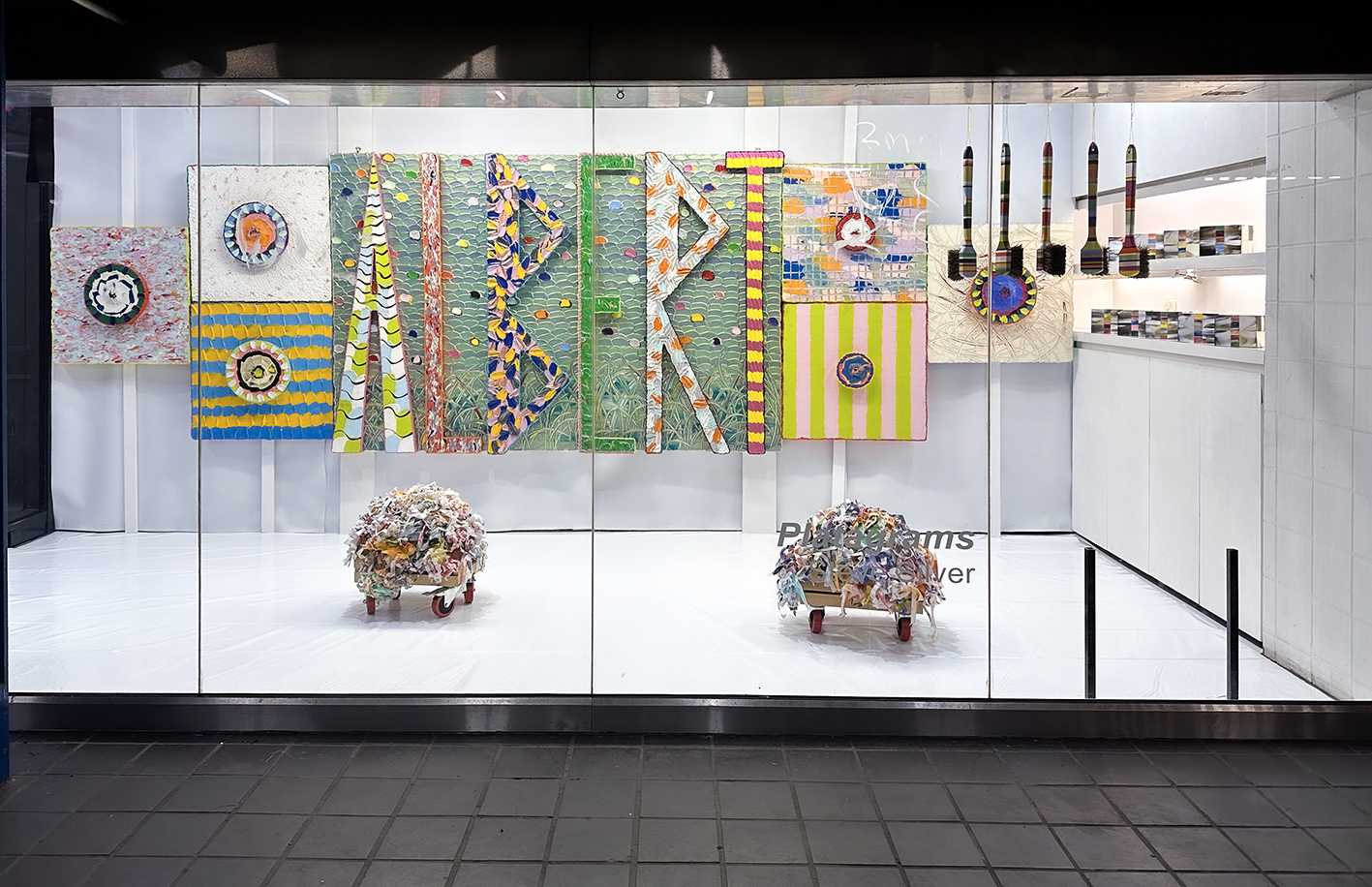
Steve Silver, ¨Albert¨.
Steve Silver’s work approaches painting from the opposite direction, emphasizing the physical and material presence of pigment itself. His piece ¨Albert¨ presents a dense field of color fragments constructed through thick accumulations of paint. Silver treats paint not as a vehicle for representation but as a substance, something that can be built, layered, and shaped until the surface becomes almost sculptural. The resulting work oscillates between painting and object, where color operates through interaction rather than composition. Installed in the vitrine, the chromatic intensity of the surface interacts with the reflections of signage and moving bodies outside, producing a shifting visual field that merges the interior artwork with the urban environment.
Together, these works articulate the central premise of Portable: that exhibitions are not static containers but evolving encounters between art, space, and public life. Emerging from nearly three decades of WhiteBox’s institutional practice, Portable operates as a critical continuation of that history rather than a break from it. By situating contemporary art within the city’s subterranean transit infrastructure, the project affirms that relevance is achieved not through isolation but through the capacity of art to remain responsive, conceptually rigorous, materially grounded, and open to the unpredictable realities of the spaces it inhabits.