
TIGHTROPE: THE MIDTERM ITCH
September 26, 2026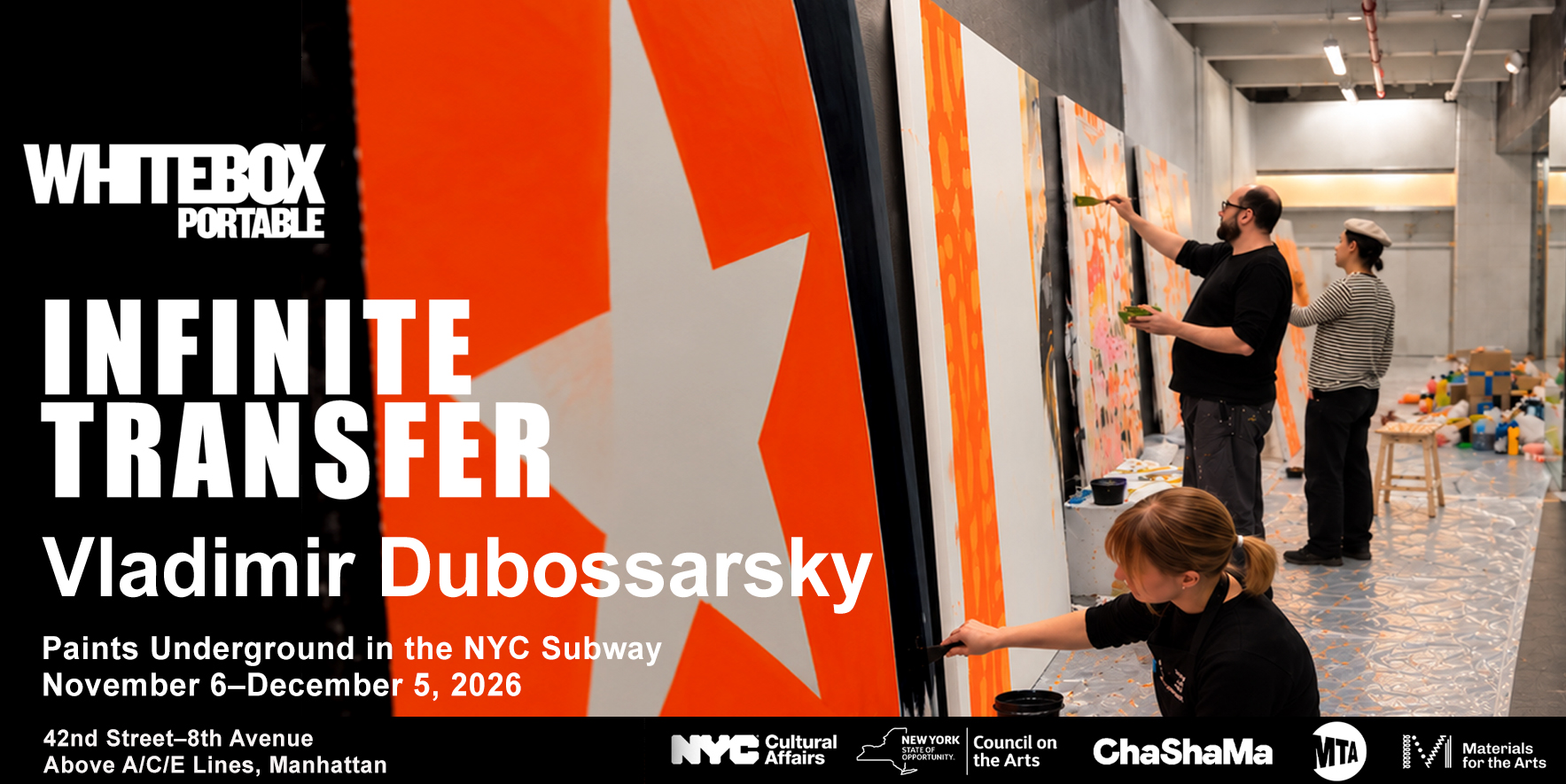
INFINITE TRANSFER
A Solo Exhibition at WhiteBox Portable@MTA
Vladimir Dubossarsky in the New York City Subway
November 6–December 5, 2026
42nd Street–8th Avenue Above A/C/E lines, Port Authority Stop, Manhattan
Infinite Transfer, a solo exhibition by Vladimir Dubossarsky, will unfold in an unexpected setting: a passageway within the New York City subway.
The underground has long been a place where culture tests its future. In fall 2026, Dubossarsky takes his practice underground—literally—creating a new body of work in the transit system beneath the city. The setting offers a fitting context for an artist long attentive to the circulation and transformation of images. Here, art, mass culture, information flows, algorithms, and social media meet in a public space defined by movement, encounter, and continual exchange.
Over the course of a month, Dubossarsky will work in an open-studio format at WhiteBox Portable @ MTA, a singular exhibition site within the 42nd Street–Eighth Avenue transit hub, at the threshold of the 42 St–Port Authority Bus Terminal complex. The project will generate both large-scale paintings and more intimate works on paper, some approaching the immediacy of sketches. Rather than presenting only finished works, the exhibition makes artistic production itself visible.
The line between viewer and activity in the space remains deliberately porous. Passersby may encounter Dubossarsky at work, enter into conversation, and, through chance exchange or recurring contact, become participants in the evolving project. The public is invited to contribute to the making of the works through these encounters, observations, and conversations. WhiteBox Portable and the surrounding passageway thus function at once as studio, public laboratory, and exhibition space.
Life in the subway passageway—exhibition visitors, passersby, and unexpected or recurring encounters—will provide a point of departure for the new works, though never their only source. Dubossarsky will also draw on broader impressions of New York: its museums, bars, cinemas, hotels, parks, and other public spaces.
A central motif in both the works and the exhibition as a whole is a state of in-betweenness. It is intrinsic to the site: a passageway is neither departure point nor destination, and those moving through it rarely regard it as a final stop. In this sense, the title Infinite Transfer refers not only to the visitors’ experience, but also to the movement of artistic language itself—from everyday life into a space of collective artistic action, then into painting, and back into life. The exhibition will emerge through these crossings, remaining in motion and open to transformation until its final day.
In a broader sense, the project considers how the geography of art has changed. Art no longer appears only in protected, purpose-built spaces that require a deliberate visit; it also circulates within the visual flows and shifting patterns of attention that shape everyday life. The artist’s role has shifted accordingly. Rather than withdrawing to produce an autonomous object, the artist may work within a shared field of images, events, and encounters—observing, selecting, and redirecting attention. Infinite Transfer takes this condition as both its subject and its working method: an experiment in the artist’s place within a culture where the making and circulation of images are no longer exclusive privileges.
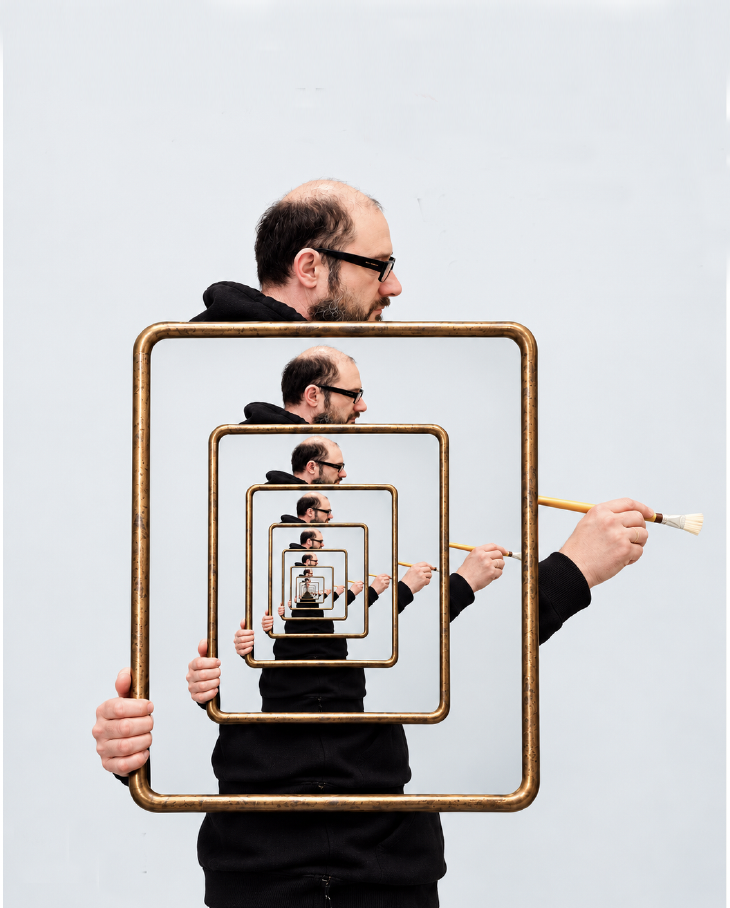
Vladimir Dubossarsky (b. 1964, Moscow) studied at the Moscow Art School in Memory of 1905 and the V. I. Surikov Moscow State Art Institute. From 1994 to 2014, he worked in an artistic duo with Alexander Vinogradov. In 2003, the duo participated in the Russian Pavilion at the Venice Biennale. Dubossarsky is a Corresponding Member of the Russian Academy of Arts. His works are held in the collections of the Museum of Fine Arts, Houston; the Nasher Museum of Art at Duke University; the collection of Jeffrey Deitch; the State Tretyakov Gallery; the State Russian Museum; the Moscow Museum of Modern Art; and the Centre Pompidou.