
UNDERGROUND POETRY FOR UNSETTLED TIMES
July 1, 2026
TIGHTROPE: THE MIDTERM ITCH
August 5, 2026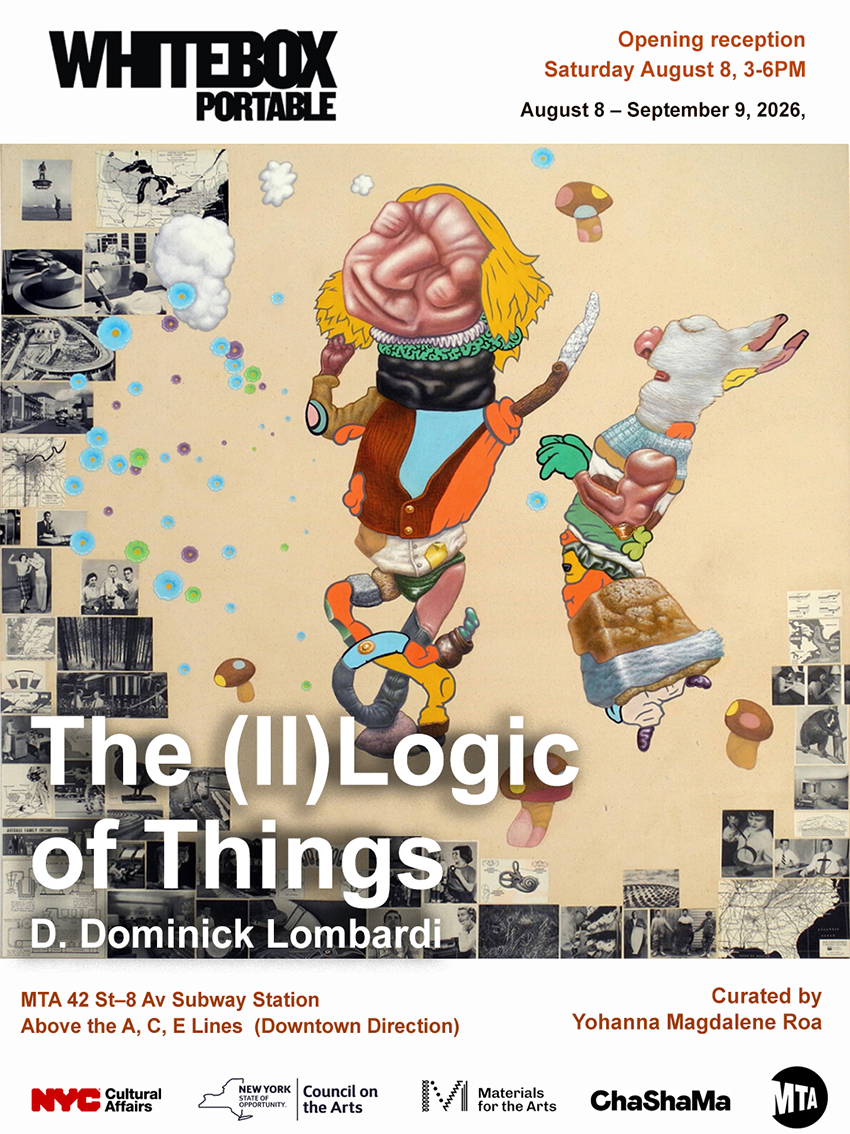
D. Dominick Lombardi and QinZa Najm
The (Il)Logic of Things / The Garden We Carry
By Yohanna M. Roa
Curator
WhiteBox Portable @ MTA presents The (Il)Logic of Things by D. Dominick Lombardi and The Garden We Carry by QinZa Najm. Both artists share an interest in the capacity of material culture to produce knowledge beyond representation. Through assemblage, collage, painting, and installation, they reveal that objects not only preserve memory but also organize relationships among histories, affects, and everyday experience. Although their material vocabularies differ, both understand the reconfiguration of objects as a means of generating new forms of meaning.
Objects retain the traces of their making, the labor that produced them, the uses they have accumulated, and the many histories they silently carry. Rather than erasing those experiences, their surfaces allow different temporalities, uses, and meanings to remain simultaneously present. At the same time, they contain unrealized futures, thereby acquiring the potential to participate in new constellations of meaning. Both Lombardi and Najm begin precisely from this moment of transformation. Their practices recover materials and objects that have already lived other lives, not to preserve them as relics, but to activate the memories they contain. Assemblage becomes a way of thinking through matter itself, where fragments cease merely to illustrate history and instead begin to reconstruct it.
Dominick Lombardi understands history as a constellation. By bringing together objects and images that seemingly share neither time, place, nor function, he subverts the rational logic of classification and constructs unexpected relationships among temporalities, affects, and memories. As in Aby Warburg's Atlas Mnemosyne, meaning does not reside in isolated objects but in the field of relationships that emerges between them.
His sculptures and mixed media paintings activate mnemonic processes that reorganize historical experience rather than simply represent it. Fragments relinquish their original identities to enter new systems of association, where assemblage becomes a mode of historical inquiry. Sand, papier-mâché, plaster, wood, antique books, industrial objects, toys, photographs, maps, and documentary fragments converge into hybrid formations that evoke both archaeological remains and speculative futures. Humor, playful distortions, and exuberant color initially seduce the viewer; yet beneath this formal richness emerge violence, consumerism, historical amnesia, and the contradictions of contemporary experience.
Equally fundamental is Lombardi's relationship to matter. From his father and grandfather, he inherited not only the craft of woodworking but also an ethic of making grounded in attentiveness, patience, and respect for materials. There exists an intelligence of the hand that precedes conceptual thought: a form of knowledge born from contact, weight, texture, resistance, and duration. His works preserve this tactile intelligence, transforming matter itself into a living archive.
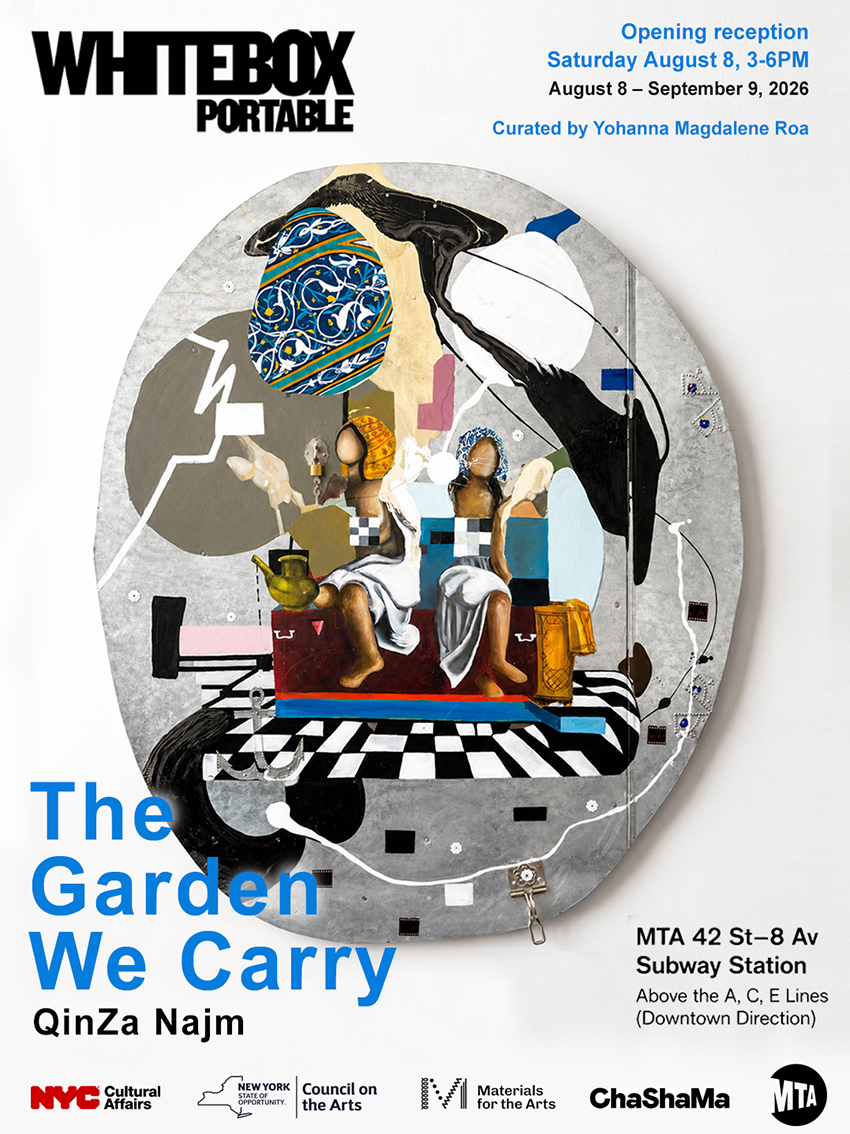
Conceived as an immersive installation, The Garden We Carry by QinZa Najm transforms everyday objects into landscapes of transition, where what was once destined for movement opens itself to new possibilities for rootedness. Rather than representing arrival, the installation occupies the productive interval where things are no longer what they once were, yet have not fully become something else. Suitcases no longer carry belongings. Shoes no longer lead anywhere. Industrial steel relinquishes its structural function. Moss, preserved foliage, reclaimed metal, and found objects remain suspended between what they once were and what they have yet to become.
The installation proposes that transformation does not occur after arrival but precisely in the course of transit. Reclaimed materials retain the traces of their previous lives while opening themselves to new forms of growth. Rather than replacing one function with another, Najm places objects in a state of fertile uncertainty, where identity remains under construction and memory becomes the ground from which new forms of existence emerge. Their previous functions are not erased but held in suspension, allowing new possibilities to remain open before settling into another form. Her gardens are not bounded places but portable territories where movement ceases to oppose rootedness, and where the act of dwelling can arise even in the midst of passage.
Although their visual languages differ, both artists understand assemblage as an act of reconfiguration. Neither pursues nostalgia nor restoration. Their works reveal objects as active agents of cultural memory, capable of carrying histories into the present while generating new relationships among people, places, and time. In both practices, materials cease to respond exclusively to the functions for which they were conceived, becoming instead active agents of new relationships and meanings.
Within WhiteBox Portable @ MTA, these ideas acquire a particular resonance. Situated at the threshold between Times Square and the Port Authority Bus Terminal, the exhibition inhabits one of New York City's most intense infrastructures of movement, where millions of people and the objects that accompany them—suitcases, shoes, bags, books, tools, and packages—circulate daily alongside maps, advertisements, and signs, forming an immense assemblage in constant transformation. Within this context, Lombardi's material constellations and Najm's transitional landscapes converge into a shared reflection on transit as a condition of contemporary experience. WhiteBox Portable @ MTA becomes the space where their meanings continue to be reconfigured, reminding us that every infrastructure is also an ecology of relationships in which past and future coexist in perpetual motion.