
UNDERGROUND POETRY FOR UNSETTLED TIMES
June 7, 2026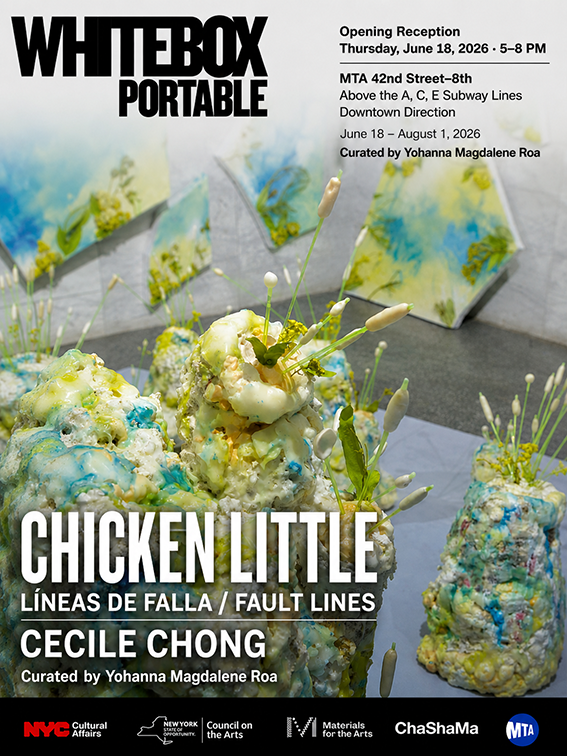
CECILE CHONG AND CHIN-CHIH YANG at Whitebox Portable at the MTA
June 18 – August 1, 2026
Opening reception June 18 6 – 8 pm
Curated by Yohanna Magdalene Roa
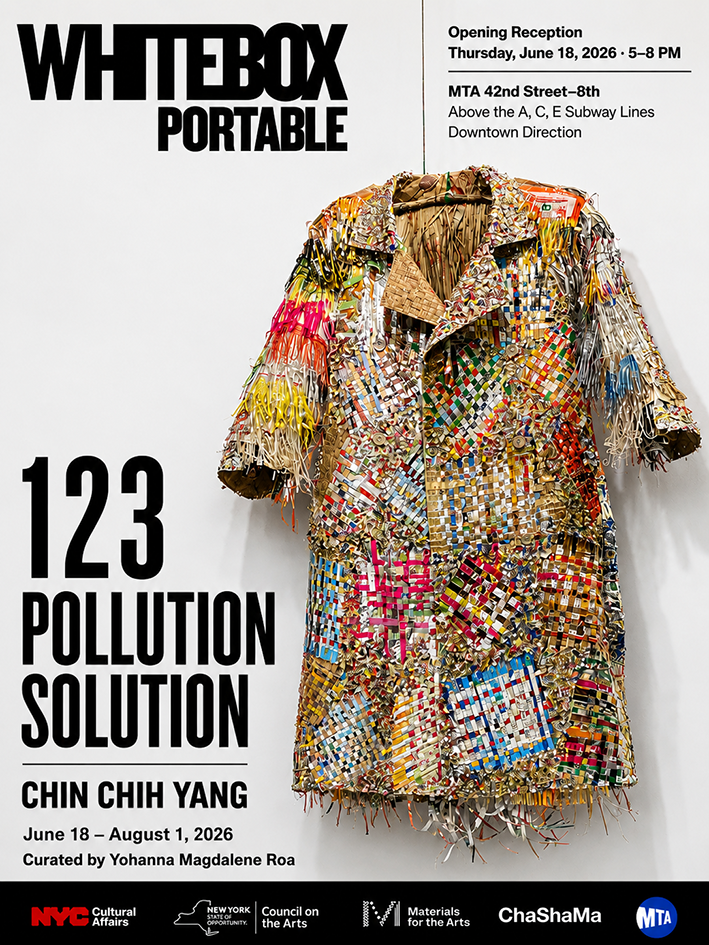
Whitebox Portable is pleased to present CHICKEN LITTLE – LÍNEAS DE FALLA / FAULT LINES by Cecile Chong and 123 POLLUTION SOLUTION by Chin-Chih Yang, two installations that transform a transit corridor traversed daily by hundreds of thousands of people into a site for reflecting on our relationship with the environments we inhabit, transform, consume, and move through.
Although formally distinct, both artists share a transnational experience shaped by migration and cultural displacement. Born in Ecuador to Chinese parents, Cecile Chong navigates histories of movement between Latin America, Asia, and the United States. Chin-Chih Yang, born in Taiwan and based in New York, has long examined the environmental consequences of industrial production and consumer culture. Their practices emerge from different trajectories, yet converge in a sustained concern for ecological interdependence and the ways human actions shape the landscapes we occupy.
For this iteration of Chicken Little, Chong situates her installation above the constant vibrations of the subway system, drawing a connection between the movement beneath Manhattan and the volcanic terrain of her native Ecuador. Referencing the Avenida de los Volcanes, the work evokes a world in which instability is not an exception but a condition of existence. Fragmented forms suspended across the walls suggest a sky in the process of breaking apart, while simultaneously resisting collapse. Botanical elements embedded within the surfaces point to the persistence of life amid uncertainty, creating a landscape suspended between rupture and regeneration.
Yang's 123 Pollution Solution approaches environmental questions from another direction. Triggered by his experience visiting recycling plants in the 1990s and witnessing the toxic byproducts generated by industrial waste management, the artist transforms discarded materials into sculptural forms that are at once seductive and unsettling. Constructed from recycled paper, aluminum cans, plastic, currency imagery, and consumer debris, his works expose the cycles of consumption that underpin contemporary life while proposing participation, reuse, and collective responsibility as forms of action. Rather than positioning the public as passive spectators, Yang invites viewers to imagine themselves as active agents within larger ecological systems.
Presented together within one of New York City's busiest transportation hubs, these projects reveal two complementary ways of understanding environmental crisis. Chong directs our attention toward the invisible forces that accumulate beneath the surface—geological, emotional, historical, and migratory. Yang focuses on the visible residues of human activity and the urgent need to rethink patterns of production and consumption. One speaks through memory, landscape, and the slow pressures of the earth; the other through material transformation, public engagement, and environmental accountability.
At a time when ecological instability increasingly shapes everyday life, both artists remind us that the ground beneath us is neither fixed nor neutral. Whether through the latent force of a volcano or the accumulation of discarded objects, the environments we inhabit are constantly being remade. Situated within the flows of commuters, workers, travelers, and tourists moving through the station each day, these installations invite us to recognize our participation in those processes and to imagine new forms of coexistence, care, and responsibility toward the worlds we collectively create.